
Why More Clients Won’t Fix Your Accounting Firm: Michelle Weinstein on Better Clients, Boundaries, and AI


IN THIS ARTICLE
Key Takeaways
- More clients can make an accounting firm less profitable when weak pricing, poor fit, and unpaid work follow every new engagement.
- AI can reduce preparation time, but it cannot replace the firm owner’s role in sales conversations, pricing, boundaries, and client trust.
- A client’s list of AI-generated questions can reveal a need for a properly scoped advisory conversation instead of more free answers.
- A repeatable response to every “quick question” helps the firm gather the right records, diagnose the real issue, and price the work clearly.
- Proactive client reviews give firms useful reasons to start conversations before a problem becomes urgent.
More clients will not fix an accounting firm when every new engagement brings weak pricing, unpaid questions, and more work than the team can handle. The better path is to choose clients carefully, charge for the problems the firm solves, and use a repeatable sales process to set clear expectations from the start.
That is the central idea in Episode 2 of Prompt & Loss, a Veltrix podcast hosted by Bohdan Sitarskyi. Michelle Weinstein, founder of The Abundant Accountant, joined Bohdan to discuss why firm owners undervalue their expertise, how AI changes client expectations, and why stronger relationships matter more as the same tools become available to everyone.
Michelle is an entrepreneur and sales strategist who helps CPA, EA, accounting, tax, bookkeeping, and fractional CFO firm owners communicate their value and sell higher-level services without pressure or burnout. Through The Abundant Accountant, her clients have collectively added more than $38 million in revenue without simply working longer hours or chasing more clients.
Watch or Listen to the Full Conversation
Watch Michelle and Bohdan discuss pricing, client fit, AI, unpaid advice, proactive service, and the sales process firm owners need to protect their time.
Watch the episode on YouTube, listen on Spotify, or listen on Apple Podcasts.
Why can more clients make a firm less profitable?
More clients increase revenue only when the work is priced well, clearly scoped, and delivered without exhausting the owner or the team. Otherwise, volume magnifies the problem.
A poorly matched client can bring repeated questions, extra work outside the engagement, rushed deadlines, and pressure to discount. Add several clients like that, and the firm may be busier without becoming more profitable. The owner spends more time delivering work and less time improving the business, speaking with promising prospects, or helping good clients at a higher level.
Michelle’s advice is direct:
You do not need more clients. You just need better quality clients.
“Better” does not mean the largest company or the client with the biggest immediate budget. It means a client whose needs fit the firm, who respects the process, understands the value of the work, and is willing to pay for the right level of help.
That requires selection. A firm owner needs to know which clients belong in the practice, which work belongs in each package, and which warning signs should lead to a clear no. Without those decisions, growth can turn a firm into a demanding job that the owner cannot step away from.
What does AI change—and what still depends on the firm owner?
AI can make preparation faster. It can organize information, compare records, surface unusual changes, and help a professional find the first issue worth reviewing. That can free time for work that depends on judgment and conversation.
It does not decide which clients the firm should accept. It does not set a price the owner can explain with confidence. It does not hold a boundary when a client asks for more than the engagement includes. And it does not build trust through a difficult conversation.
Those responsibilities still sit with people.
This is why Michelle treats the firm owner as the firm’s most important salesperson. The word “sales” can feel uncomfortable to accountants who associate it with pressure. In this context, it means understanding a client’s problem, deciding whether the firm can solve it, explaining the service clearly, and agreeing on a fair scope and price.
AI may help the firm reach that conversation with better information. The owner still needs the confidence and process to lead it.
Why can a client’s AI-generated questions be a useful signal?
A client may arrive with ten or twenty questions copied from an AI chat. That can feel like another demand on the firm’s time. It can also reveal something important: the client is worried, unsure what to trust, or looking for help that goes beyond the current engagement.
The wrong response is to answer every question immediately and hope the exchange stays short. A list that took the client seconds to generate may require the accountant to review the books, check earlier work, understand the business context, and decide which questions matter. What looks like a quick reply can become a substantial piece of unpaid work.
The better response is to treat the questions as the beginning of a professional conversation.
The client has already shown that the issue matters to them. The firm can now ask what prompted the questions, gather the records needed to examine them, and decide whether the work fits the current service or needs a separate scope.
The value is not in answering a longer list. It is in helping the client understand which problem deserves attention and what a reliable next step looks like.
How should a firm handle the “quick question” without giving away the work?
Michelle uses a doctor’s appointment to explain the process. A doctor does not diagnose a complicated problem from a rushed message. They arrange the appointment, request the relevant tests or records, and then examine the full picture.
An accounting firm can use the same logic:
- Recognize the signal. A “quick question,” an unexpected tax concern, or a long AI-generated list may point to a larger problem.
- Schedule the conversation. Move the request out of an informal message and into a proper meeting.
- Gather the records first. Ask for the books, prior returns, financial statements, contracts, or other information needed to understand the issue.
- Diagnose before proposing. Review the evidence, identify what the client actually needs, and decide whether to recommend a new service, a change in scope, or no additional work.
This is not about charging for every brief interaction. It is about recognizing when a question cannot be answered responsibly without real preparation.
A consistent process helps both sides. The client receives a considered answer instead of a rushed opinion. The firm protects its time and can explain why additional work belongs in a separate engagement.
How can proactive advice support a higher-value service?
Waiting for a client to ask a question is still reactive. The firm becomes more useful when it can spot something important and start the conversation first.
That does not mean manually reviewing every report for every client every week. Most firms do not have the time. It means building a practical first-pass review that helps the accountant see where their attention is most useful.
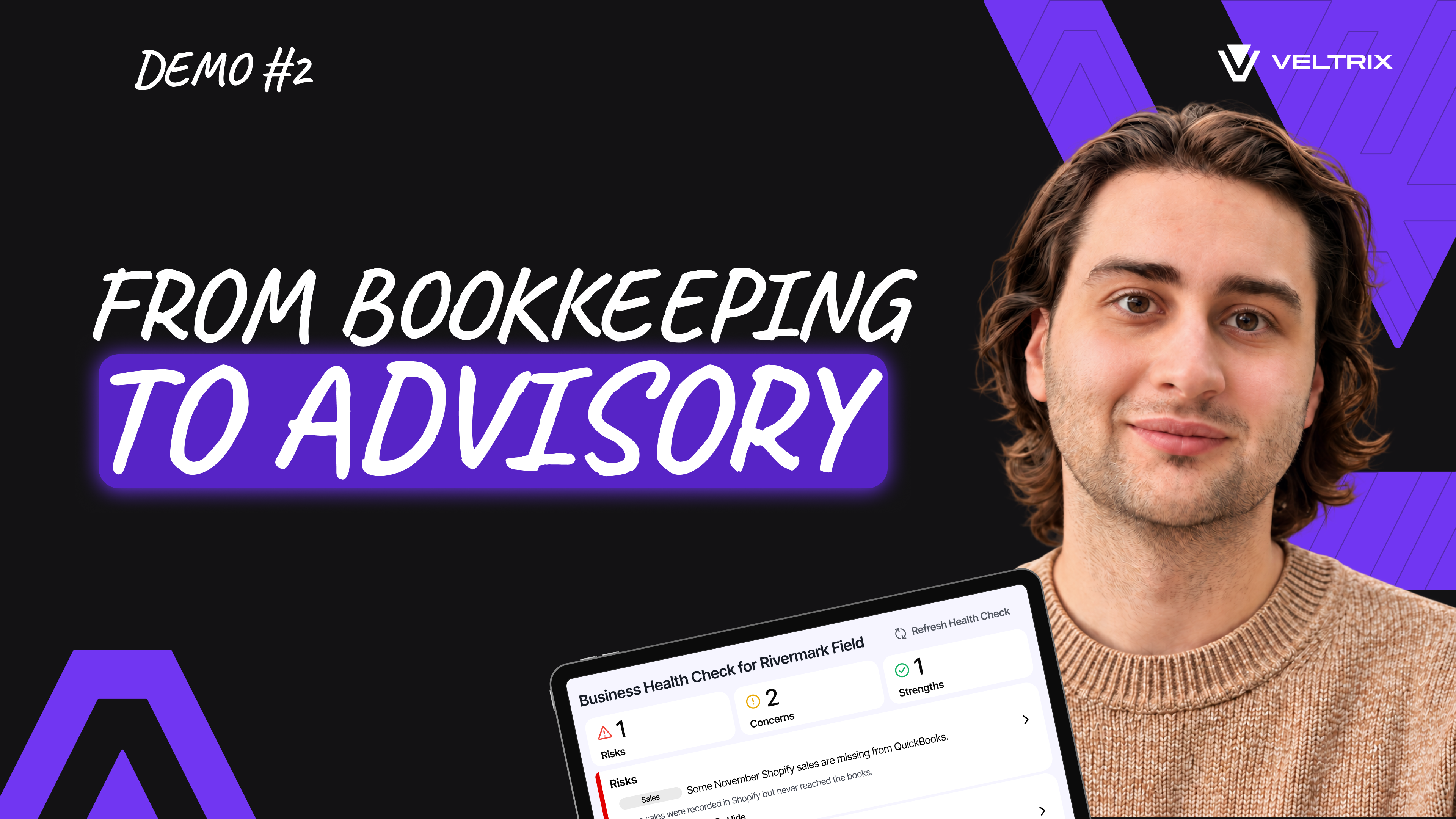
With the free Veltrix Business Health Check, a firm can review connected client data and see a short list of issues, strengths, and questions worth investigating. The accountant can open the information behind a finding, decide whether it matters, and add the client context that the records do not contain.
One finding might show a cost growing much faster than sales. Another might point to slow collections or an unusual transaction. The software supplies a starting point; the accountant decides whether the change is meaningful and how to discuss it.
This creates a more concrete way to show value. The client is not being asked to buy an abstract promise of “advisory.” They can see the issue, why it deserves attention, and what the accountant proposes to do next.
A finding does not automatically justify a higher fee. The firm still has to review it, define the work, and explain the outcome. But it gives the conversation a factual place to begin.
What should a firm owner do in the next few weeks?
The episode ends with three practical moves.
First, list the work that repeatedly causes frustration: unpaid questions, difficult clients, vague scopes, weak pricing, missed follow-ups, or tasks that consume hours every month. The list shows where the current process is breaking down.
Second, choose one low-risk use of AI and learn how it behaves. That might be a personal task or a familiar internal workflow. Then test a finance-specific tool on a real example the firm knows well. Compare the result with the firm’s own review instead of assuming the first answer is correct.
Third, create one consistent response to the next “quick question.” Decide how the meeting will be scheduled, which records the client must provide, and how the firm will separate a brief clarification from work that needs a new scope.
Small repetitions build confidence. The goal is not to transform the entire practice in one week. It is to replace one source of chaos with a process the firm can use again.
What is the real path to a stronger accounting firm?
A stronger firm is not simply a busier one. It has clients who fit, services with clear boundaries, prices the owner can explain, and enough time to do work that clients genuinely value.
AI can help by reducing repetitive preparation and showing the accountant where to look. It cannot choose the firm’s clients, lead its sales conversations, or protect its boundaries. Those are business skills the owner still needs to build.
The practical combination is straightforward: use technology to reach the important issue faster, then use professional judgment and a clear sales process to decide what happens next. That is how a firm can grow without turning every new client into more hours and more stress.
Where can you learn more from Michelle Weinstein?
If your firm still feels like a job you cannot escape, The Abundant Accountant offers a free strategy call to help you map a path toward clearer packages, stronger pricing, and better-fit clients. Book a free strategy call at TheAbundantCall.com.
You can also visit The Abundant Accountant or follow Michelle on LinkedIn, Instagram, Facebook, her personal Facebook profile, and YouTube.
Accounting professionals can explore Veltrix for accountants and the Partner Firm Program, watch the full episode on YouTube, listen on Spotify, or listen on Apple Podcasts.
Find what’s worth a client conversation