
Is Hourly Billing Dead? How AI Is Changing Accounting With Pieter Nel and Manfred Swarovski


IN THIS ARTICLE
Key Takeaways
- AI will not end hourly billing overnight, but it makes hours a weaker way to show value when the same preparation can be done much faster.
- AI can handle repetitive first-pass work, while the accountant checks the evidence, adds context, and decides what to recommend.
- A useful accounting AI needs the right data and a workflow built for the job, not just a powerful general chatbot.
- Connected data can help accountants spot an important change before the next monthly report or client request.
- A good first test is one low-risk task where the firm can compare the AI result with its own review.
AI will not make hourly billing disappear overnight. But when software can finish the preparation faster, time spent is no longer a good way to show value. For accounting firms, the opportunity is simple: let AI handle repetitive first-pass work, then spend more time checking the facts, explaining what matters, and helping clients decide what to do.
That was the main question in the first episode of Prompt & Loss, a Veltrix AI podcast hosted by Bohdan Sitarskyi. Technology executive and AI advisor Pieter Nel joined Manfred Swarovski, co-founder and CEO of Veltrix AI, to discuss how AI is changing accounting work, what clients expect, and how firms show their value.
Pieter is a fractional CTO, technology executive, and AI advisor with more than 20 years of experience. He previously served as CTO at CloudFactory and Ocrolus, advised organizations on AI strategy at McKinsey, and earned an MBA from MIT Sloan. A Veltrix advisor, he was also the first South African to complete a solo flight around the world in a single-engine aircraft.
Manfred approaches the topic as a business operator and co-founder and CEO of Veltrix. His work in the family business showed him that large companies had analysts and expensive systems, while smaller businesses often did not. He co-founded Veltrix to help close that gap. He holds a BBA and MBA from the University of San Diego and brings an international business perspective to the company.
Watch or Listen to the Full Conversation
Watch Pieter, Manfred, and Bohdan discuss hourly billing, connected business data, specialized AI tools, and the work that still needs human judgment.
Watch the episode on YouTube or listen on Spotify.
Is hourly billing really dead?
No—at least not everywhere. The more useful point from the conversation is that hours become a weaker way to show value when AI cuts the time needed for research, review, and preparation.
Pieter saw the same change in management consulting. If a tool can do in minutes part of the research that once took a team many hours, the client is less interested in how long the preparation took. The client still cares whether the result is useful, correct, and clearly explained.
Manfred expects accounting firms to feel the same pressure as more clients use AI. That does not mean every firm should stop billing by the hour—the episode did not compare pricing models or every type of engagement. The simpler point is that when routine preparation gets faster, firms need to show clients what they are paying for besides time.
Bohdan brought the discussion back to what clients actually notice. They may never see how many hours went into the work, but they do notice when their accountant spots a problem early or helps them make a better decision.
What becomes valuable when fewer hours are needed?
Faster preparation does not tell a firm how to price its work. But it does make one thing clearer: time spent and value delivered are not the same.
Pieter’s consulting example makes this easy to see. When research takes minutes instead of many hours, the client judges the finding, the explanation, and the decision it supports. Manfred added that as AI becomes more common, clients may expect routine preparation to cost less or to come with more useful work.
For firms, that means showing clients what came out of the work. Maybe a problem was caught early. Maybe the scope became clearer. Maybe the client can now make a decision or ask a better question in the next meeting. A longer invoice does not prove that the result is better.
Pieter saw a similar pattern in software development. He did not say accounting will follow exactly the same path. His point was simpler: when AI speeds up the work, the final review can matter more, not less.
An AI tool may also be missing parts of the story: an agreement, a one-time event, the owner’s plans, or an earlier client conversation. The accountant still has to decide whether the finding holds up and what the client should do with it.
Why can a specialized AI tool save more time than a general chatbot?
Pieter pays for a specialized presentation tool because it removes hours of formatting while still producing work that meets his standards. The AI model behind it is not the main reason it saves him time. The whole workflow is.
A general chatbot may answer a question quickly. But the user may still need to export reports, explain the business, rewrite the prompt, and trace the answer afterward. If those steps remain, the tool may speed up the first draft without saving much time overall.
Manfred’s point was that a specialized tool can wrap AI around one job. In accounting, that means bringing in the right business information, asking questions that fit the work, and showing the evidence an accountant needs to check.
So the better question is not, “Which AI writes the best answer?” It is, “Which tool removes the most work and still gives me an answer I can check?”
Why can connected data save time before the review even starts?
A client review takes time before anyone asks the first question. Someone has to gather the reports, compare periods, and work out which system holds each part of the answer.
Manfred used QuickBooks and Shopify to show why this matters. The books show one view of the business; the store shows another. Manually checking both across every client, every day, would take more time than most firms can justify. When those sources are connected, the accountant can spend less time assembling the first picture.
In Veltrix, an accountant can bring QuickBooks and Shopify into one workspace, ask what changed across sales, cash, and costs, then open the reports behind the answer. Veltrix analyzes those sources without changing them, so the accountant can check the evidence and add client context before raising the issue.
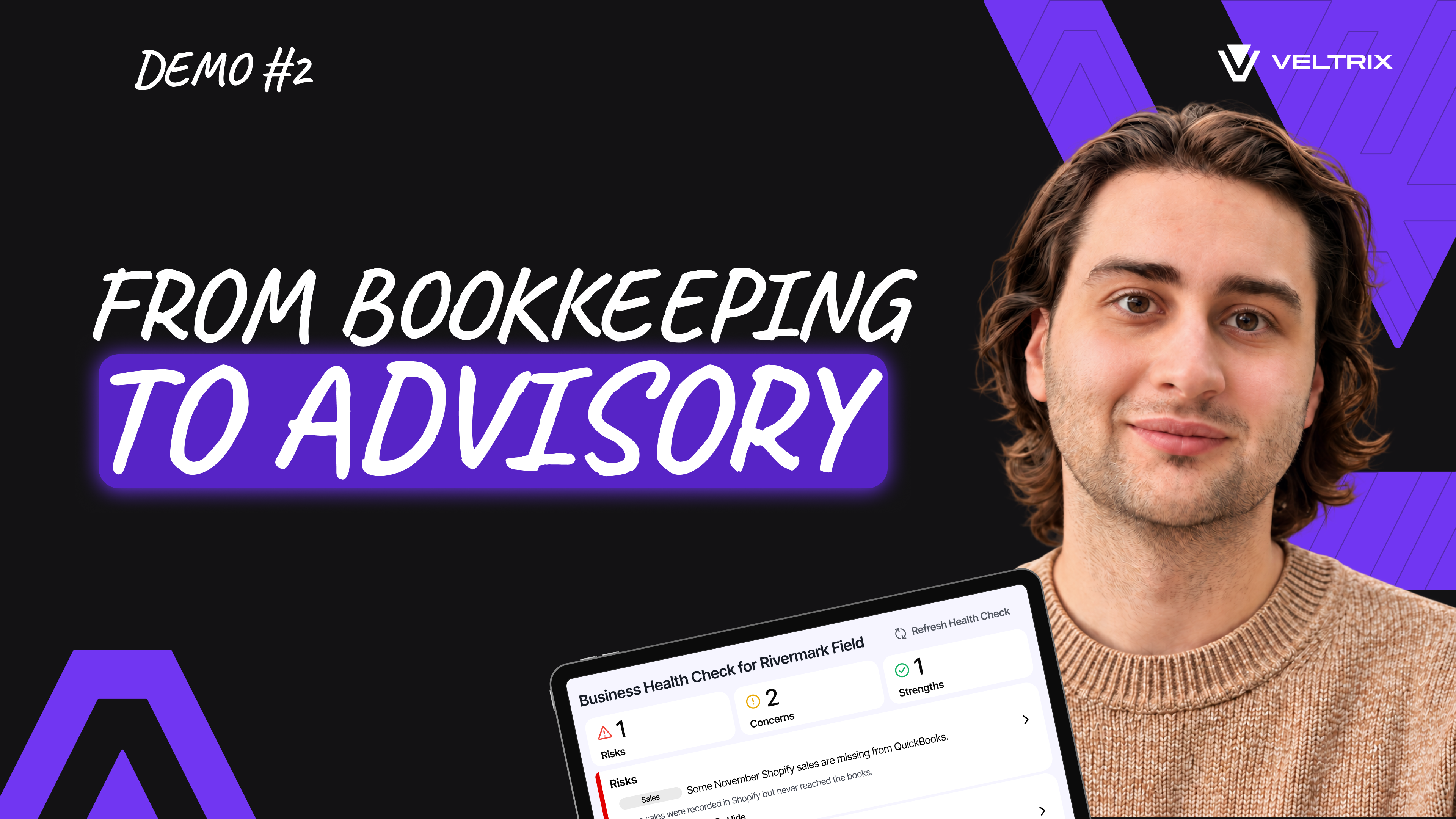
The free Business Health Check provides a short first review of risks, concerns, and strengths in about two minutes. Its value is not simply a faster answer. It reduces the time needed to find a useful starting point while keeping the supporting reports available for review.
A quick answer is not much help if checking it takes longer than doing the work by hand.
How should an accounting firm choose an AI tool?
Five questions can help:
- What job are you asking the tool to do? “Use AI” is not a workflow. Reviewing a new client, checking for unusual changes, preparing a meeting, or explaining a cash movement are clear tests.
- Can it work with the information that job requires? A fast answer based on one incomplete report may create more review work, not less.
- Can the accountant trace the result? The reviewer should be able to see which records support the answer and where information is missing.
- What is the tool allowed to change? For review and analysis, read-only access keeps the source systems under the user’s control.
- Where does a person review the work? A useful tool should make that step clear instead of presenting every AI answer as final.
A long feature list will not tell you whether a tool helps. These questions show whether it can cut preparation time and still give the accountant something reliable to discuss with the client.
How can a firm tell whether an AI workflow creates real value?
Choose one repeated, low-risk task the firm already knows well. Use the firm’s own business or one client who has given permission.
Then compare the whole process before and after. How long did preparation take? How much time did the review take? Was it easy to check the sources? Did the final result give the client a clearer question or decision? A faster draft is not enough if it creates more checking or leaves the evidence unclear.
Pieter shared one prompt that can improve this kind of test: “What questions did I not ask?” It can pull out something the first prompt missed. The answer still needs review, but it may reveal a gap in the way the problem was framed.
The Veltrix Partner Firm Program gives accounting professionals a way to test this with client work. Run one Business Health Check, review the strongest finding, and compare the complete process with the firm’s usual preparation.
Do not measure only how quickly the AI responds. Measure whether the full, reviewed job becomes faster, clearer, and more useful to the client.
So is hourly billing dead, or is accounting value changing?
Hourly billing is not suddenly dead, and the episode does not argue that every firm should replace it. But AI is weakening the old link between hours worked and value delivered. When part of the preparation becomes faster, clients have more reason to care about the finding, the judgment behind it, and the decision it supports.
For accounting firms, the next step is practical. Let AI take on repetitive first-pass work. Keep the evidence check, business context, recommendation, and client conversation with the accountant. Choose tools by the work they improve, not by the model name or the amount of text they generate.
The goal is not to put AI into every task. It is to use it where it genuinely saves time, check what it produces, and turn that saved time into better work for clients.
Explore Veltrix for accountants, watch the full episode on YouTube, or listen on Spotify.
Find what’s worth a client conversation