



How to Find Client Advisory Opportunities in About Two Minutes With Veltrix


IN THIS ARTICLE
Key Takeaways
- Proactive advice starts with seeing a change the client may not have noticed yet.
- The free Client Business Health Check can surface risks, concerns, strengths, and advisory opportunities in about two minutes.
- In the demo, Veltrix turns returns, shipping costs, and customer retention into three specific client conversations.
- Each finding shows what the data supports and what is still missing, so the accountant knows what to ask before recommending anything.
Accountants can find useful advisory opportunities without spending hours reviewing every report for every client. In this walkthrough, Veltrix checks QuickBooks and Shopify data through the Business Health Check and finds three conversations worth having in about two minutes.
The example follows an existing ecommerce client whose day-to-day bookkeeping appears routine. The review shows that returns are taking a serious bite out of sales, shipping costs have tripled while revenue grew by about half, and customer retention has improved.
That mix matters. It gives the accountant two concerns to investigate and one strength to help the client build on. More importantly, it shows how to move from a change in the numbers to a better client question while keeping the accountant’s experience and the client’s knowledge at the center of the advice.
How does the full advisory walkthrough work?
The video follows the client review from the first Business Health Check to the questions an accountant could raise with the client.
Watch it below, or open the demo on YouTube.
Why are useful advisory opportunities easy to miss?
An accountant can know a client well and still miss a change that deserves a conversation. The clues are scattered across reports and business tools, while the firm is already handling regular bookkeeping, accounting work, month-end close, and deadlines.
With one client, spending twenty minutes investigating an unusual cost may be manageable. Across ten, thirty, or fifty clients, that same review becomes hours of work on top of the agreed service.
That creates a quiet gap. The accountant may sense that a client needs more help but does not have the time to search every report for a useful reason to call. The client may see that sales were “good” without noticing that returns are eating into them or that shipping is getting more expensive much faster than revenue.
The opportunity can disappear before the conversation begins—not because the accountant lacks experience, but because the first clue takes too long to find.
What changes after a two-minute Business Health Check?
In the demo, QuickBooks and Shopify sit inside the client’s own Veltrix workspace. The accounting data shows one part of the business. The store data fills in another. Veltrix analyzes both without changing anything in either source.
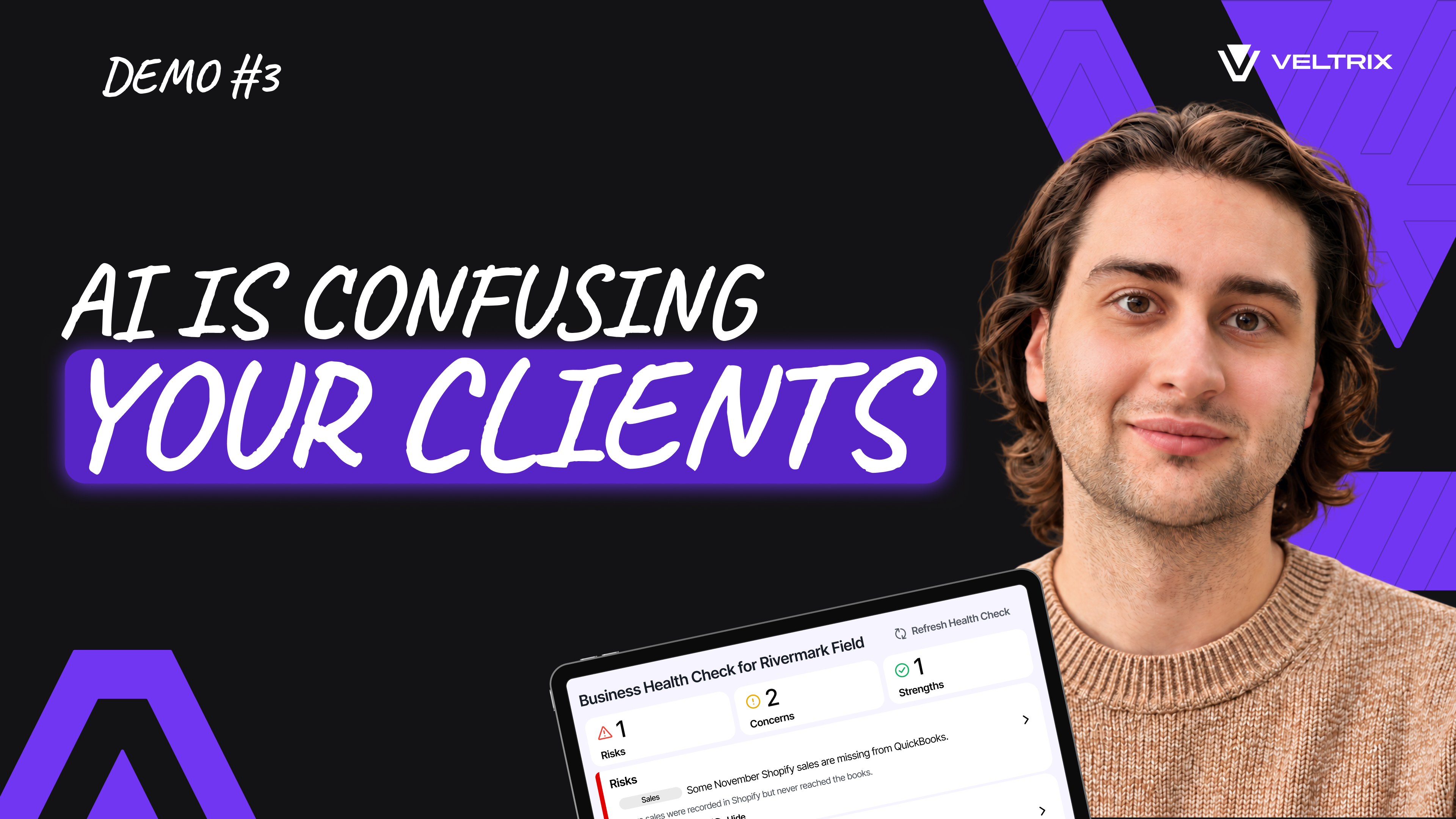
The Client Business Health Check turns that connected data into a short view of risks, concerns, and strengths. About two minutes later, the accountant can see that shipping costs are growing faster than sales, returns are costing more than the lost sales alone, inventory has fallen sharply, and monthly profit is swinging too much to rely on.
These are not just bookkeeping issues. They point to questions about pricing, operations, customers, inventory, and growth.
Now the accountant is not wondering whether there is anything worth discussing. The question becomes, “Which of these changes matters most right now?”
Which three client conversations does the data uncover?
The accountant asks Veltrix for the three most important changes or opportunities worth discussing, why each one matters, and one question to ask the client. Two concerns and one strength stand out.
What is driving the increase in returns?
In the demo, returns represent roughly 17% to 23% of gross monthly sales in the periods Veltrix highlights. This is no longer just a line in the books. It raises questions about product quality, customer expectations, fulfillment, and which products are coming back most often.
A useful client question could be:
What changed in the products, customers, or fulfillment process during the months when returns increased?
The accountant now has a clear place to begin. The next conversation can connect the financial effect with what the client knows about the business.
Why are shipping costs rising faster than sales?
The same review finds that outbound shipping costs have tripled while revenue grew by about 50%. Sales are moving in the right direction, but the cost of delivering those sales is moving much faster.
The data can show when the change happened and how large it was. The client may know whether the cause was a new carrier, larger packages, faster delivery promises, a different product mix, or something else.
A useful question could be:
Did anything change in your carrier, packaging, fulfillment process, or delivery options when shipping costs began to rise?
What caused customer retention to improve?
Not every advisory opportunity begins with a problem. Veltrix also finds that customer retention has jumped.
The owner may have noticed individual customers returning without seeing the wider pattern. Once the change is visible, the conversation can move from “That is good news” to “What caused it, and can the business repeat it?”
A useful question could be:
What changed before more customers started coming back, and is there a way to build on it?
Together, these three findings give the accountant a balanced conversation: one revenue leak, one fast-growing cost, and one strength worth developing.
How does the accountant learn what the data cannot explain?
A finding can show what changed without explaining every reason behind it. That missing context is often where the client’s knowledge and the accountant’s judgment matter most.
The demo uses a simple follow-up question:
What does the data suggest is happening? What can’t the data tell me, and what should I ask the client before recommending any action?
Veltrix checks the connected sources, explains what the records support, and identifies what is still unknown. If a needed source or detail is missing, it says so instead of filling the gap with invented information.
This gives the accountant a better way to prepare. The data supplies the evidence. The unanswered questions shape the meeting. The accountant brings both together before making a recommendation.
How does one finding become a useful client conversation?
The shipping-cost finding gives the firm a reason to call, but the value comes from how the conversation begins.
Instead of saying, “Your shipping looks expensive,” the accountant can be specific:
I noticed that outbound shipping costs have tripled while revenue increased by about half. The data shows when the change began, but it does not show whether your carrier, packaging, fulfillment process, or delivery options changed. What was happening in the business around that time?
Because the observation comes from the client’s own records, the client can immediately see why the conversation matters. The question gives them room to add the missing context.
From there, the accountant can decide whether the issue needs a quick answer, a deeper analysis, or a separately scoped advisory project. The Health Check can also be exported, and a view-only dashboard can give the client a simple visual to review without logging in.
How can the same review work across several clients?
This matters even more when the firm manages a full client portfolio.
Veltrix keeps each client in a separate workspace. The accountant can review one client without mixing their data with another, while managing all of those workspaces from one account. A client can also be invited to connect another source, upload a file, or join the same conversation.
That makes a simple monthly rhythm possible. One client may have a cost problem. Another may have weakening sales. A third may have a strong customer segment worth developing. The accountant does not need to search for the same signal in every business; the Health Check helps reveal what is different for each one.
Why can two minutes change the advisory relationship?
A two-minute review changes where the accountant’s work begins. Instead of searching through every report and hoping to find something worth discussing, the accountant starts with a short list of changes backed by the client’s data.
In this example, that short review uncovered a costly return problem, shipping costs growing far faster than sales, and a rise in customer retention. Each finding led to a question the client could answer and the accountant could use to decide what deserved a closer look.
That is how the Business Health Check can make proactive advice practical across more clients. Veltrix finds the first clue and shows the supporting data. The accountant adds context, decides what matters, and leads the conversation.
Run a free Client Business Health Check with an existing client. Accounting and bookkeeping firms can also join the free Partner Firm Program.
Find what’s worth a client conversation

.png)
.png)