

How to Assess a New Accounting Client in About Two Minutes With Veltrix


IN THIS ARTICLE
Key Takeaways
- A client who asks for simple bookkeeping may also need cleanup, reconciliation, or missing records fixed first.
- The free Client Business Health Check can reveal that hidden work in about two minutes instead of hours.
- Comparing QuickBooks with Shopify or another business tool can uncover problems that neither system shows on its own.
- By the time you prepare the quote, you have clear findings to shape the scope and explain the price.
The demo opens with a familiar request: an ecommerce client needs regular bookkeeping. It sounds like a straightforward job and an easy quote.
Then the records begin to tell a different story. A large unexplained cost has appeared. Returns and refunds do not line up. Shipping looks off. What sounded like regular bookkeeping may also involve cleanup, reconciliation, and hours of work the client does not know exists.
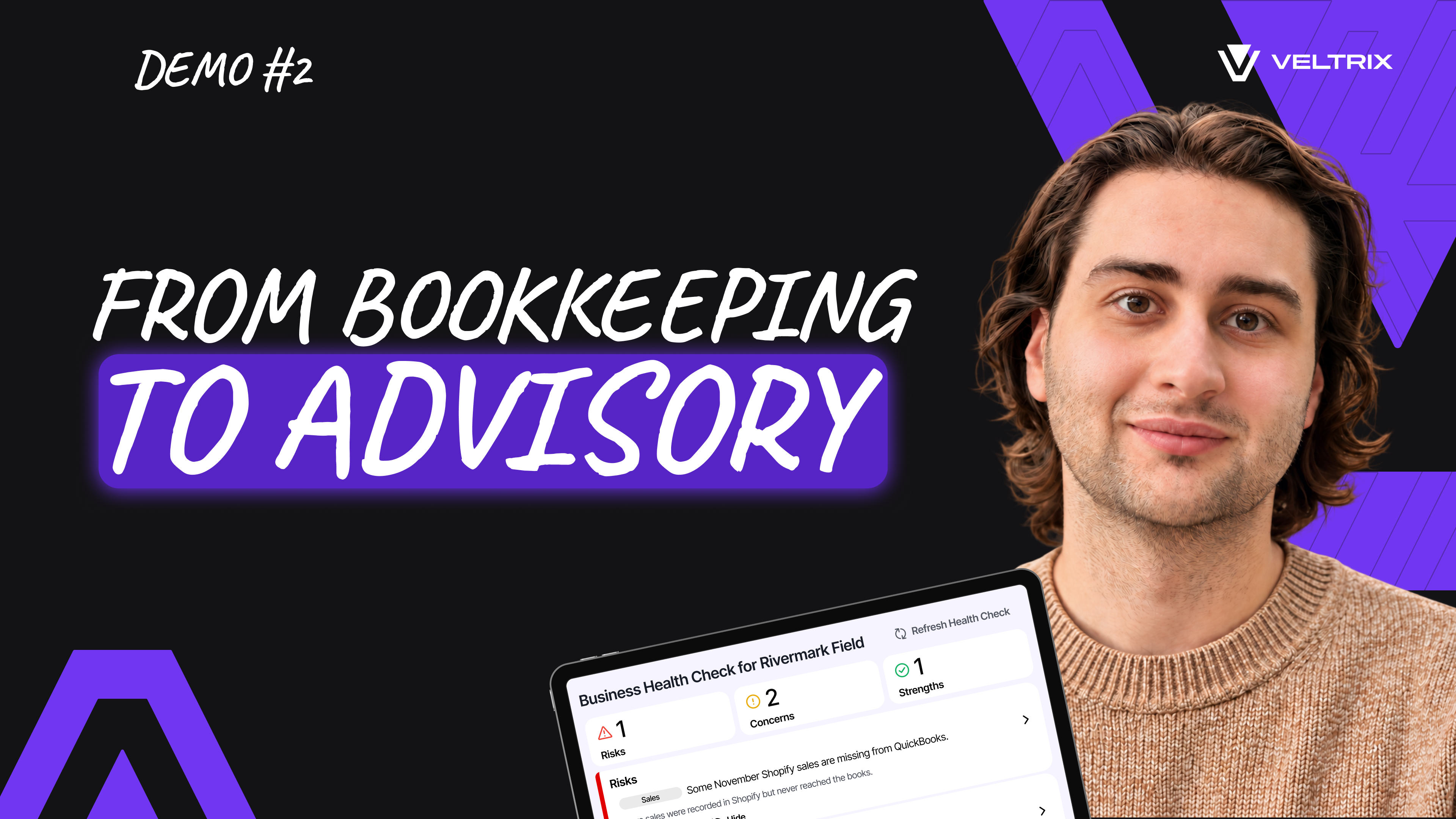
This is where Veltrix changes the process. Instead of spending hours looking for the first problem, the accountant runs a free Client Business Health Check. About two minutes later, the hidden work is visible—and the quote can be based on what the client actually needs.
How does the full client assessment work?
The full walkthrough follows this assessment from the first look at the client’s data to a clearer scope for the proposal.
Watch it below, or open the demo on YouTube.
Why can a simple bookkeeping request hide more work?
Most business owners are not trying to hide a mess. They simply may not know it is there. They know they need someone to handle the books, but they may not know about duplicate entries, missing transactions, unreconciled accounts, or problems in the chart of accounts.
That leaves the accounting firm with a difficult choice. Quote the job too early, and the team may inherit hours of unpaid cleanup work. Review every account, file, and business system first, and the firm can spend hours on discovery before the client has agreed to anything.
The real question is not only, “What service did the client ask for?” It is also, “What has to be fixed before that service can be done properly?”
What changes after the two-minute Health Check?
In the demo, QuickBooks and Shopify are connected inside the client’s own Veltrix workspace. The books show one part of the business; the store shows another. Veltrix can read both without changing anything in either system.
The accountant runs the Client Business Health Check. About two minutes later, the first picture of the business is ready.
The Health Check shows a large unexplained cost, return costs that look high compared with refunds, shipping costs that deserve attention, and marketing spend that is high next to profit. It also shows the strengths of the business, so the assessment is not simply a list of problems.
At this point, the engagement already looks different. The accountant is no longer searching blindly through records. The likely issues are on the screen, grouped by what needs attention now and what deserves a closer look.
Why can the biggest clue sit between QuickBooks and Shopify?
One of those findings leads to a bigger question: do the Shopify returns and refunds match the entries in QuickBooks?
Veltrix compares the two sources and points to partial refunds, exchanges, shipping, gross sales, and discounts that do not line up cleanly. Those differences would be easy to miss when reviewing QuickBooks alone because the missing part of the story lives in Shopify.
Now the firm can see that the job may involve more than monthly bookkeeping. The records may need to be reconciled across both systems before the regular work begins. A problem that was invisible in the original request has become part of the scope.
How do the first findings become the real scope?
The Health Check gives the accountant the first clues. The next step is understanding how much work those clues may create.
In Ask AI, the accountant asks:
Help me define the cleanup scope for this client. What needs attention, what information is still missing, and what should I check before accepting the work?
The answer brings the scattered issues together. It lays out the likely priorities, the effort involved, reconciliation work, balance-sheet and chart-of-accounts concerns, information still needed from the client, and what all of this could mean for the proposal.
The accountant still brings the experience needed to judge the findings and set the price. But the hours of gathering, comparing, and organizing the first evidence have already been reduced to minutes.
By now, the original request has become a much clearer engagement: regular bookkeeping, the cleanup that needs to happen first, the questions the client must answer, and the records that need to be reconciled.
How does the quote become a conversation instead of a surprise?
A higher quote is difficult to explain when all the client sees is a number. It is easier when the firm can show what the records revealed and why the extra work matters.
The conversation can now begin with specifics: the unexplained cost, the mismatch between Shopify and QuickBooks, the reconciliation work, and the information still missing. The client can see that the scope comes from their own records rather than an arbitrary fee.
If the numbers are easier to understand visually, the accountant can also create a view-only dashboard and share it without asking the client to log in. The dashboard gives both sides something concrete to discuss.
What began as “We need help with bookkeeping” has become a transparent plan for what needs to happen first, what the ongoing service will include, and why the quote reflects that work.
Why spend two minutes before you promise hours?
A good quote starts before the number. It starts with understanding what is really inside the client’s records.
The Client Business Health Check turns the first hours of manual searching into an assessment that takes about two minutes. From there, Veltrix helps the accountant follow the clues, compare the systems, and understand the work hiding behind the request.
The result is not just a faster review. It is a better conversation with the client and a quote the firm can clearly explain.
Run a free Client Business Health Check with a new or existing client. Accounting and bookkeeping firms can also join the free Partner Firm Program.
Find what’s worth a client conversation

.png)